Revolutionary War Battle of Long Canes Brought to Life with Unveiling of Interpretive Paintings in Troy; USCOG Funded Project for Greenwood, McCormick County SC250 Committees

Brushstrokes, not gunfire, told the story as a large crowd gathered in the Town of Troy to watch two newly unveiled paintings bring an American Revolutionary War skirmish back to life.

Each canvas, painted by retired park ranger Eric Williams, offers the artist’s carefully researched vision of how chaos and courage unfolded in the Battle of Long Canes. Williams most notably served as the chief ranger at the Ninety Six National Historic Site.

The skirmish occurred in December 1780, near the border of what is now Greenwood and McCormick counties. “Long Canes” was the name given this part of the frontier landscape for its dense canebrake thickets that grew on the richest soil. They were said to have provided cover for soldiers and local militia.

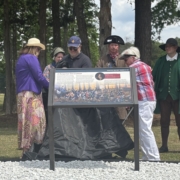
Community members, local dignitaries and history enthusiasts gathered at the Battle of Long Canes Interpretive Signage Installation Service Saturday at Wisteria Park in Troy.

The event was part of the state’s 250th-anniversary celebration of the American Revolution in South Carolina (1770–1783), focusing on education, historic preservation, and tourism. Each county in the state has an SC 250 committee.

The Greenwood and McCormick County SC 250 committees jointly applied for funds for Battle of Long Canes interpretive signage. The State SC 250 Committee awarded the grant and provided $15,000 for the signs. USCOG Government Services Director Rick Green submitted the grant application and helped administer the project.

Several dignitaries spoke before the tarps were removed to reveal reproductions of two Williams paintings and a map which provides special context to the Battle of Long Canes whose exact location is still undetermined.

Green and former McCormick County SC Chamber of Commerce & Visitor’s Center Director Nancy Lindroth unveiled “A Surprise Encounter,” which depicts South Carolina and Georgia militiamen sneaking up on enemy British Loyalists stealing chickens and pigs, etc., from a local farm. The narrative of the painting also refers to the Ninety Six battle site, Colonel Elijah Clarke, Brigadier General Andrew Williamson, and Colonel Andrew Pickens:

“In early December 1780, Patriot Col. Benjamin Few and about 500 South Carolina and Georgia Militia were encamped at Long Canes, pleading with Pickens and Williamson, as well as other local backcountry citizens (for supplies and support). On December 12, 1780, Lt. Col. John Harris Cruger, the Loyalist commander at Ninety Six, ordered Lt. Col. Isaac Allen to take an equivalent number of Loyalists to White Hall in search of the Patriot militia. Hearing of Loyalists plundering farms in the area, Patriot Col. Elijah Clarke called for a hundred volunteers from Col. Fews’ encampment to follow him and fight or capture the Loyalists. Around sunset, as the Patriots were scouting the high ground above the bottoms of Long Cane Creek and Reedy Branch, Clarke and his party surprised a small band of Loyalist militia who were helping themselves to supplies and livestock from a nearby farm. The Loyalist foragers fled towards their own camp. The Patriots gave chase, hoping to overtake them until the larger Patriot force could arrive.”

Williams’ other painting titled “Retreat and Aftermath” referred to the Patriot defeat at the hands of the Loyalists in the Battle of Long Canes, followed by a decision by Pickens to free himself from parole and take a leading role in the pivotal American victory at the Battle of Cowpens in January 1781.

“Clarke’s overconfident Patriots dismounted and hastily advanced across a small rise that had blocked their view of Lt. Col. Allen’s encampment. The Patriots raced in with muskets and were stunned to see hundreds of startled men, including red-coated Regulars, hurriedly fixing bayonets, forming lines, and preparing to fire. The Loyalist counterattack quickly caused a chaotic retreat by the Patriots, of up to three miles, with wagons and plundered livestock abandoned as night fell. The larger Patriot force never arrived. The Patriots took heavier losses, including serious injuries to Clarke and other officers. Most narrowly escaped, although casualty accounts do vary in this skirmish. However, shortly after this Patriot setback, Col. Andrew Pickens renounced his parole and, a month later, commanded the Patriot Militia at the Battle of Cowpens some 95 miles to the north, a victory for the Patriots. The tide of war was again turning towards independence for the colonies.”

After the ceremony concluded, the crowd moved into the Troy Community Center to view the original acrylic paintings…

The process leading up to the unveiling of the interpretive signs was a couple years in the making, President of the Greenwood County Historical Society Chip Tinsley told the crowd before the signs were unveiled.

“For hours upon hours upon hours, we had boots on the ground. We looked for new information. We tried to verify old information. We spent many months looking, researching, finding,” Tinsley said.

“Someone asked me, ‘Why was this an important battle? What did it mean? Why was it something we needed to learn about?’ The Battle of Long Canes was an important event in the back country of South Carolina. And we’re very proud to be a part of memorializing that,” Tinsley added……..

Senator Billy Garrett said, “Ordinary Americans, like you and me, are part of an extraordinary story of the American Revolution. This was not a distant battle. This was our home. These were not professional soldiers. These were our ancestors. These were our neighbors. These were our family members. And our fellow citizens. And yet their story is no less important than all the great battles of the war fought throughout the United States.”

Former McCormick County 250 historian Wayne Ehrensberger implored those in attendance to study the paintings.

“When you see the interpretive signs try to fully absorb the scenes depicted by Eric, which accurately portray fine details of the period, including such things as the long cane growing in the background, specific breeds of livestock — one of which is a personal favorite, and the various types of clothing. Soldiers wearing green coats were members of the British trained NJ Loyalist Volunteers,” he said.

Ehrensberger gave a detailed presentation on the Battle of Long Canes and referred to other battles as well.

“On May 12th, 1780, the British defeated the large American force defending Charleston which inflicted such a staggering blow that many of the South Carolina militiamen feared the war may be lost,” Ehrensberger said.

Skirmishes moved westward with the American Patriots losing the Battle of Camden in August. But the Patriots won the Battle of Musgrove Mill in present day Laurens County a few days later and also at Kings Mountain in October.

Also around that time, the British Loyalists occupied the village of Ninety Six. They wanted Williamson and Pickens on their side, as Ehrensberger further explained.

Efforts by Patriot forces in the Long Cane settlement went beyond simple recruitment. Acting under orders from Major Gen. Nathanael Greene, they sought to harass British troops entrenched at Ninety Six while attempting to bring two key backcountry leaders—Andrew Williamson and Andrew Pickens—back into the fight. Both men were on parole, and reports that the British were courting their allegiance only heightened Patriot urgency. Williamson had already cast his lot with the British, effectively inviting their occupation at Ninety Six, while Pickens remained undecided but ultimately declined to rejoin.

Tensions escalated when British officials pushed for harsher parole terms, a move widely seen by Patriots as a betrayal meant to force neutrality or even turn former comrades against one another……..

The situation worsened after repeated but unsuccessful attempts to persuade Williamson and Pickens. Frustrated Patriot troops retaliated by raiding Williamson’s property at White Hall, seizing provisions intended for British forces. Cruger dispatched roughly 450 troops under Isaac Allen to pursue the Patriots, hoping to catch them off guard.

What followed was a costly miscalculation. A Patriot detachment under Colonel Clarke, expecting only minor resistance, encountered Loyalist militia foraging a local farm and attacked. But in pressing forward, they unknowingly advanced into Allen’s full force. …….

The Loyalists quickly regrouped, formed ranks, and launched a fierce counterattack. Clarke’s men, suddenly outmatched, fought desperately as reinforcements failed to arrive. Clarke was severely wounded, and other officers, including Lt. Col. James McCall and Major John Lindsay, suffered devastating injuries amid the chaos.

The Patriots ultimately broke and retreated under heavy pursuit. Survivors regrouped only to find their main camp already in withdrawal, reportedly ordered by Colonel Few. Under cover of darkness, the battered force scattered – some fleeing toward Georgia, others toward North Carolina – abandoning supplies and livestock. The clash underscored both the volatility of divided loyalties in the backcountry and the high cost of misjudgment in a war where intelligence and timing often proved decisive.

“It was a confounding Patriot loss. But it was also the beginning of the end for the British,” Ehrensberger said, referring to future Patriot victories at Cowpens and other locations in the South.

Upper Savannah Land Trust Director and Greenwood 250 Commissioner Wade Harrison talked about the location of the Battle of Long Canes, which is still up for debate……..

“That is one of the maddening questions that actually remains unanswered: where should we put the marker for the Battle of Long Canes,” Harrison asked.

“I think it is important to understand here that questions, uncertainties, and gaps in knowledge do not mean that historians have somehow failed. It means the study of history is still relevant, and there is still a lot to learn, and that stories we’ve been comfortable with can be challenged with new evidence, fresh analysis, and just finding stuff (skirmish artifacts) in the woods,” Harrison said.

“This is what history is supposed to do, and it’s happening even as we commemorate these historic events,” Harrison said.

City of Abbeville Celebrates Grand Re-Opening of CDBG Funded Chestnut Street Park

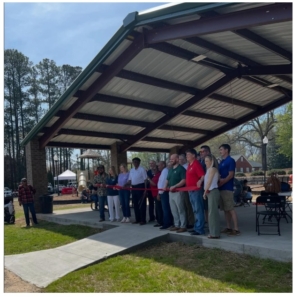
Appropriately, it was a beautiful spring day for the City of Abbeville to celebrate the Grand Re-Opening of Chestnut Street Park Saturday, March 21.

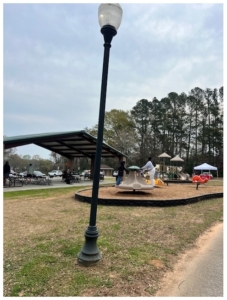
The City received $250,000 in Community Development Block Grant (CDBG) funds to upgrade the park located at 400 Chestnut St. Improvements include playground equipment, picnic tables, mulch, park-style grills, and an open-air pavilion.

Additional work included site preparation, installation of purchases, designated American Disabilities Act parking, and concrete work.

Upper Savannah COG’s Community Development staff submitted the grant application to the S.C. Department of Commerce and also administered the project. City of Abbeville Deputy Administrative Officer Mike Clary played a leading role as well.

.A large group of residents including many children, and also elected and other officials attended the ribbon-cutting ceremony with the following social media statement from the City.

“Thank you to everyone who came out to celebrate the Chestnut Street Park Grand Re-Opening. We are especially grateful for the support of City Council, our State Representatives, the Chamber of Commerce, the Upper Savannah Council of Governments, and all of the community residents who made today so special.

“This park project represents more than just a new space, it’s part of a larger commitment to Parks & Recreation improvements, quality of life investments, and ongoing Downtown Revitalization efforts outlined in our Comprehensive Plan.

“We’re also proud to share that over 90 percent of the project cost was funded through grants, helping us maximize impact while being responsible stewards of taxpayer dollars.

“Most importantly, this is a place for our kids and families, a safe, welcoming space where children can play, gather, and grow right here in our community.

.“We can’t wait to see the positive impact this park will have for years to come. Thank you, Abbeville, for continuing to show up and support the future of our city!”..

Saluda County EMS Director Emphasizes the Importance of CDBG Project’s Potential to Save Lives

Saluda County Emergency Medical Services Director Jacob Starnes is thankful for a Community Development Block Grant which will fund life-saving equipment for a county which does not have an emergency medical facility. “There is no telling when a patient might need it,” he said.

Saluda County will receive $65,872 to purchase equipment to store and transport vital lifesaving pre-hospital blood for trauma patients. The equipment will provide blood products that will aid in on-scene patient stabilization, significantly improving outcomes for patients with rapid blood loss.

“This project is extremely important and life-saving for citizens or visitors to Saluda County,” Starnes added. “This project will allow patients to receive plasma and packed red blood cells pre-hospital in the back of an ambulance in a county that doesn’t have a hospital.”

The grant will provide funding for an autonomous portable refrigeration unit blood cooler, a compact disposable unit, blood administration kits and more accessories.

The grant award was announced earlier this week, the first of its kind ever announced by the SC Department of Commerce. Upper Savannah COG Community Development staff prepared and submitted the grant application to the State.

The equipment and accessories will likely be purchased in a few months since all CDBG projects include a start-up phase.

Saluda County does not have a hospital or emergency medical facility to aid in emergency calls. Patients must be transported by ambulance or air medical services to the nearest emergency medical facility.

The closest emergency room facilities for Saluda County are Edgefield County Hospital (29 minutes), Newberry County Memorial Hospital (approximately 34 minutes), and Self Regional Hospital in Greenwood (approximately 39 minutes)..The nearest Level III trauma centers are Self Regional and Lexington Medical Center in Lexington. Aiken Regional Medical Center is a Level IV trauma center.

“People automatically think trauma when they think of getting blood products,” Starnes said. “However, while researching this wonderful grant opportunity, we noticed that over the past year we could/would have given blood products more to medical patients (GI bleed, OB/GYN complications, profound hypotension with positive shock index) than trauma patients.”

The emergency medical call history in Saluda County revealed approximately 17 cases in 2024 that fell into the statewide blood administration protocol. These cases include seven traumatic incidents, eight gastrointestinal-related cases, and two obstetric/gynecological hemorrhages.

Starnes said this project will improve survival by rapidly restoring oxygen carrying red blood cells and delivering vital clotting factors and proteins to stop bleeding effectively.

“I am super excited to get to work on this project and blessed that we are able to get these products with the assistance of this grant,” he said.

Starnes said that packed red blood cells and plasma are essential in bridging the gap until hospital care can be given. “It reduces mortality and extends survivability in both medical and trauma patients when there is not quick access to a hospital,” he said.

CDBG Grants Will Award Life-Saving Equipment to Saluda County, Facility Improvements in Greenwood, Abbeville Counties

Life-saving equipment for Saluda County is among three Community Development Block Grants awarded to the Upper Savannah Region, the State announced this week.

Grants were awarded to Saluda, Greenwood and Abbeville counties. Upper Savannah COG Community Development staff prepared and submitted the grant applications to the S.C. Department of Commerce in the fall CDBG round.

Saluda County will receive $65,872 to purchase equipment to store and transport vital lifesaving pre-hospital blood for trauma patients. The equipment will provide blood products that will aid in on-scene patient stabilization, significantly improving outcomes for patients with rapid blood loss. Some EMS staff are already certified in blood administration while others will be trained if needed.

Saluda County does not have a hospital or emergency medical facility to aid in emergency calls of this magnitude. Patients must be transported by ambulance or air medical services to the nearest emergency medical facility located outside the county.

The closest emergency room facilities for Saluda County are Edgefield County Hospital (29 minutes), Newberry County Memorial Hospital (approximately 34 minutes), and Self Regional Hospital in Greenwood (approximately 39 minutes). The nearest Level III trauma centers are Self Regional and Lexington Medical Center in Lexington. Aiken Regional Medical Center is a Level IV trauma center.

This project total is estimated to cost $73,372, including a $7,500 local match.

It was the first of its kind grant application to the State.

“Jill Warren contacted me to inquire whether it was eligible for funding through our CDBG program,” Upper Savannah COG Assistant Community Development Director Brittany Hallman said.

Warren is Director/Airport/County Grant Coordinator in Saluda County.

“We have not previously encountered or been involved in a grant of this nature,” Hallman said. “I contacted the state, which they convened and determined it to be eligible under the current program guidelines. This type of project was also new to them.

“So (USCOG Community Development Director) Keith Smith and I arranged to meet with Saluda EMS staff to gather more details on the proposed project and went from there. The project had a lot of supportive elements to justify the equipment need.”

The emergency medical call history in Saluda County revealed approximately 17 cases in 2024 that fell into the statewide blood administration protocol, according to EMS staff member Ethan Derrick. These cases include seven traumatic incidents, eight gastrointestinal-related cases, and two obstetric/gynecological hemorrhages.

Greenwood County has been awarded $923,890 to improve the Department of Public Health facility, formally known as Department of Health and Environmental Control, located at 1736 Main Street South in Greenwood.

Funding would address the deteriorating exterior conditions, HVAC installation, parking lot improvements, and Americans with Disabilities Act (ADA) compliant restroom updates. The proposed project is estimated to cost $1,064,093, with a local match of $140,203.

Abbeville County was awarded $445,328 to improve the DSS facility parking lot located at 909 West Greenwood St. in Abbeville. A report issued by the SC Department of Health and Human Services determined that the facility parking lot was not meeting ADA compliance.

In addition to the non-compliance, other parking lot conditions include unlevel and uneven surfaces, large cracks, deteriorated parking stall lines and speed bumps, and exposed hazards. These hazardous conditions are unsafe and need to be addressed. The proposed project is estimated to cost $506,055, with a local match of $60,727.

Elvis Impersonator, Ice Cream Truck, Tattoo Station Among Highlights at Upper Savannah Senior Day

They ate ice cream, got tattoos, played games, enjoyed popcorn, won door prizes and danced to some really good music. No, these weren’t kids. But for a day, many of them were kids again.

Well over 100 seniors aged 60 and older came to Harris Baptist Church in Greenwood last Thursday to celebrate Senior Day, sponsored by the Upper Savannah Area Agency on Aging.

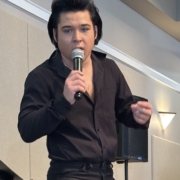
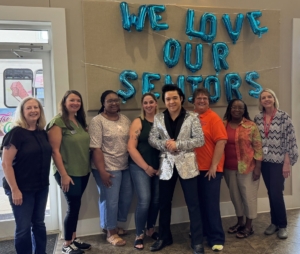
The celebration included a “senior swag” temporary tattoo station, 38 vendors providing information on community resources, a relaxation station for hand and neck massages, an ice cream truck provided by the Ice Cream Xperience, local DJ Ben Meredith, and renowned Elvis Presley impersonator Jacob Eder.

Upper Savannah Family Caregiver Advocate Aeriell Bowick organized the event with help from eight fellow Agency on Aging staff members. Bowick was not disappointed.

“Senior Day was a day to remember,” Bowick said. “I truly enjoyed watching our seniors getting to socialize, get tattoos, and just be a kid again! They enjoyed all the games we had prepared…especially bingo!

“When I first mentioned the tattoo station for Senior Day people looked at me like I was crazy…it was one of the biggest hits! I was able to be at the tattoo station for a while and was able to mingle with them. It was heart-warming to watch them be so thrilled over the tattoos they picked out.

“One lady was 81 years old, still very independent driving, working and doing for herself. She was so excited for her tattoo, and said she has always wanted one but was too afraid,” Bowick said.

The highlight of the day was undoubtedly live music provided by the 25-year-old award winning Elvis impersonator from Abbeville who has performed all over the Southeast. He belted out Elvis songs, mimicked Elvis’s famous on-stage moves, and hugged and kissed many seniors on the cheek.

“I believe they enjoyed everything we had lined up for them, but I think they were more thrilled for Elvis,” Bowick said. “They ate him up! Some seniors even got up and danced with him!

“Watching the seniors laugh and dance was the icing on the cake. The seniors left with a bag full of goodies, tatted up and their hearts full of happiness and laughter.”

Upper Savannah Director of Aging Programs Peggy Merritt said the event was “truly meaningful.”

“Aeriell Bowick receives the credit for planning this fantastic event,” Merritt said. “She had the vision, and the Aging team supported her to make this a truly meaningful event for seniors in our region.”

With 38 vendors offering an array of services, seniors learned ways to stay healthy, care for persons with dementia, meet community helpers, and learn about assistive living communities and also pre-planning funeral arrangements, Merritt said.

“Seniors attending represented various counties throughout the Upper Savannah region, and it was a diverse population,” Merritt said. “Some seniors arrived by bus or van from senior centers and assisted living facilities, while others drove themselves.

“The age of attendees ranged from 60 to 90, and everything in between. This event really linked together seniors in our community along with partners who help them meet their needs.

“I am pleased with the success of Senior Day, and I hope we will have funding available to continue sponsoring this event in the future,” Merritt said.

Dept. of Archives Gives Tips to Municipal Clerks About Record Keeping; Documents Like George Washington’s Letter Date Back to 1700s

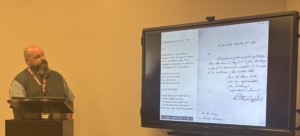
“Sir, in deliverance of the enclosed resolution I have the honor to transmit to your Excellency a copy of the amendments proposed to be added (to) the Constitution of the United States. I have the honor to be, with due consideration, Your Excellency’s most obedient servant,” signed President George Washington.

What if George Washington’s letter to South Carolina Governor Charles Pinckney Oct. 2, 1789, referring to a copy of the Bill of Rights had been lost or thrown away?

Nobody would know today that it ever existed, and a piece of history would have been lost. But this letter, written in cursive, was saved and now resides in the S.C. Department of Archives and History.

Today, hundreds of records exist in cities and towns that must be kept either permanently or at least temporarily and it’s a big job for municipal office personnel.

Chris Condon, Local Records Analyst with the S.C. Department of Archives and History (SCDAH), gave a presentation on records management to municipal clerks at a lunch meeting last week at Upper Savannah Council of Governments.

His PowerPoint presentation displayed some centuries-old documents and then covered the definition of what is considered a public record. It also featured retention schedules, storage requirements, and destruction reporting procedures.

One “memo” created in 1788 and signed by the 12 justices of the Court of Abbeville County to the inhabitants of the Indian town of Nolichucke, N.C., complained of the murder of Cherokee Indians and warned that “such aggressions must stop or (else) endanger the peace.”

“I would say that in 1788, this had administrative value,” Condon said, with a smile. “But now it has historical value. That’s why we keep public records.”

He said any government entity which receives public funding (taxes) is required to retain records.

“Public records are the public’s business,” Condon said. “Public bodies create public records.”

Records referring to land ownership, grant projects, business licenses, building permits, council minutes, audit reports, budgets, resolutions, cemetery deeds, etc., must be kept permanently. Retention methods include official paper copies, microfilm and digitation.

Other records such as business license applications, paid invoices, receipts, bids submitted by vendors, etc., can be disposed of (made unretrievable) after a certain time, according to retention schedules available on the SCDAH website. Municipalities or agencies must send documentation (an ARM-11 form) of records destruction to SCDAH.

Storage requirements include having a well-maintained area free of food, drink or vermin, well-ventilated, no extreme temperature fluctuations; no leaks, flooding of excessive moisture, with everything at least three inches above the floor.

“You’re not going to be able to guarantee 100 percent safety of your records. It’s not possible. But make every effort to,” Condon said.

He recommended keeping records not necessarily chronologically but “like records with like records” because some are permanent and some can be destroyed. And document or catalogue records so they are easier to find, he said. If you are keeping records digitally, Condon said to keep backup copies offsite.

“It’s just as important to know what you don’t have as what you do,” Condon said while suggesting keeping copies to document legal disposition of records. “If you know what you don’t have, you don’t have to spend hours going through all your records trying to find it.”

Condon told the clerks he knows record keeping is a big job.

“Nobody will ever truly understand what you do,” he said of the general public. “They are going to go, ‘oh, she just keeps the records.’ They don’t care what you have to go through to do it. But when you are able to pull that file up and hand it to them, they’re like that is ‘awesome.’”

He said when items are recorded for the first time, “they had an official purpose. Now people are using that to trace their lineage. The most important thing we do is protect South Carolina’s history.”

A public administrator’s meeting will be held Thursday, August 21 beginning at noon at the USCOG office in Greenwood. Staff members from the State Energy Office (SEO) have requested to make a short presentation on potential grant funding opportunities.

The SEO serves as the principal energy planning entity for South Carolina, through which they offer initiatives focused on energy efficiency, renewable energy, and clean transportation, including funding opportunities, technical assistance, and education, outreach, and training.


Below, Department of Archives Local Records Analyst Chris Condon reads letter from President George Washington to S.C. Governor Charles Pinckney Oct. 2, 1789.

Consultants from Montana Hoping to Help Create Transit Systems in Abbeville, Laurens and Saluda Counties

Two consultants from a far-away place are hoping to help create public transit systems for Abbeville, Laurens and Saluda counties, producing a feasibility study not intended to “sit on a shelf,” but to literally be put into motion.

David Kack and Rebecca Gleason from the Western Transportation Institute (WTI) located at Montana State University in Bozeman, Mt., came to South Carolina last week to meet face-to-face with citizens in the three counties who are interested in seeing public transit become available.

Kack and Gleason are working with Upper Savannah Council of Governments (USCOG) Government Services Director Rick Green on the project.

Green said an e-mail from the National Association of Development Organizations (NADO) last fall asked if there were any local transportation projects that might need technical assistance grant funding. Green replied that three of the USCOG Region’s counties – Abbeville, Laurens and Saluda – do not have public transportation. These three counties are among the last in the state that do not yet have a public transit option for at least a portion of the county.

NADO was awarded the grant from the U.S. Department of Agriculture, and one of the projects that will be completed from this grant will be the transportation feasibility study.

The goal of the study is to develop transportation options for the three counties, which are more than 2,000 miles from Bozeman.

“Why from Montana, so far away from South Carolina? Rick Green’s answer was because the Alaska folks are busy,” joked Gleason, who is a research engineer with WTI.

WTI began this project in March, reviewing other rural transit studies from the Upper Savannah Region dating as far back as 2010. Then they formed committees and had several online meetings and interviews with transit stakeholders.

Kack and Gleason flew in from Big Sky country last Monday for a three-day visit to Abbeville, Laurens and Saluda counties.

They started their visit by making a presentation to USCOG’s Aging Advisory Committee, in part because many citizens who need more public transit options are seniors.

“We live our lives by being mobile, whether it’s just going to the grocery store, socializing, educational opportunities, going to work, or getting to appointments. We live our lives by being able to get out and move around,” Kack told the committee.

“Unfortunately, mobility is very expensive. It’s actually the second highest expense (car payments, gas, insurance, vehicle repairs) behind housing.”

After meeting with the Aging Advisory Committee in Greenwood, Kack and Gleason visited Abbeville, Saluda and Laurens counties on consecutive days.

They learned face-to-face that “transportation challenges are a big issue,” Kack said. “People want to get this (issue) addressed. Rececca was talking about the previous studies that were done and someone said, ‘I just don’t want more studies. I want something to happen.’

“We reiterated that we also want to see something happen. I think one thing that makes us different than other consultants is I have helped start three transit systems. We don’t like writing reports that sit on somebody’s shelf. We like to see them implemented.”

Kack helped start a voucher program with Older Americans Act funding at the Deep East Texas Council of Governments. He has also helped start transit systems in Missouri and Montana.

“We know that seniors are often reluctant to ask a friend or family member for a ride,” Kack said. “Vouchers allow for them to reimburse family members or friends for rides to the grocery store or appointments.”

Kack said the lack of transportation affects many different groups.

“It can be income based,” he said. “It could be a disability that prevents you from driving. You might have a one-car family but if a family member is taking that to work, then everyone else is stuck. It’s expensive to own and operate a car.”

Medical appointments seem to be the most urgent need for transportation.

“Someone misses that dialysis appointment because of transportation and then misses a second one, then maybe it’s an ambulance to the emergency room. That’s a big expense,” Kack said.

Gleason and Kack made the most of their visits to the three counties.

“Part of what we are trying to do is come into the communities and say what are the challenges, what are those mobility needs, and find the best services,” Kack said. “We are going to look at a lot of different options. Fixed route (bus or van routes) or demand response (like Uber) aren’t always the best solution.”

Carpooling, vanpooling, volunteer drivers, voucher programs for gas reimbursement, once or twice per week medical or shopping van trips to cities (i.e., Greenville, Columbia, Augusta), expansion of current transit systems in the area, and communities contracting with micro transit companies like Via are among several considerations. Gleason recommends a mobility manager for the Region.

Also, it is possible that there could be different types of transit operating within the same county in order to respond more efficiently to specific needs. For example, a vanpool could take workers to an industry and home again daily while a smaller vehicle could be available by appointment to take people to medical facilities.

The main obstacles to rural transit in this region are cost, available vehicles, and hiring and training drivers.

WTI will complete its study in September, hoping that each of the three counties can find a solution that best fits their needs following months of online and in-person meetings.

“We can do a lot of good planning and hopefully somebody can pick up that ball and move it forward,” Kack said. “We will be around (after September) to help.”

Kack recommends that communities give their transit systems of choice time to achieve success.

“You will learn more in the first year of operating the system than all the planning you did prior to it,” he said. “Give it two to three years to catch on and see how it gets used. Give it enough time to really understand how it’s going to work.”

Sewer Rehab Project in Mathews Mill Community Has Been Completed; Other Current CDBG Projects in Final Phases of Construction

One of several current Community Development Block Grant (CDBG) projects has been completed with a second phase of sewer line replacements in the Mathews Mill community in Greenwood County.

The Upper Savannah COG’s Community Development staff applies for and submits the grant applications to the S.C. Department of Commerce on behalf of local governments and entities.

Greenwood County received $1,600,000 in CDBG funds in August 2022 to continue sewer improvements in the Mathews Mill area, with Greenwood Metropolitan District (GMD) providing $1,503,399. The total project cost was estimated to be $3,103,399.

The project will benefit approximately 303 people. Project construction has been completed. Closeout monitoring was held June 3.

The Matthews Mill II Sewer Project was a second phase for the area, this phase involving installation of approximately 825 feet of 12-inch and 5,200 feet of eight-inch gravity sewer line, 23 new precast concrete manholes, and the reconnection of 109 structures to these new lines.

Construction took place on Georgia Street, Bolt Avenue, Bond Avenue, Stevens Avenue, and Cross Street in the Mathews Mill community.

GMD Director of Communications and Governmental Relations Tony Williamson said the sewer lines serving Mathews Mill village residents were between 80 and 100 years old.

“It was vitrified clay pipe and it greatly exceeded its useful life,” Williamson explained. “There was a joint every four feet and the materials that were used 100 years ago to seal the joints have long since deteriorated.

“It allowed (tree) roots, ground water, all of that to get into the pipes. As the small roots got into the pipes, they grew and created cracks in the pipes. Once those roots get in there, grease will adhere to them and that’s the beginning of a blockage.”

The old lines were replaced from behind the mill houses and moved nearer to the streets.

“Those sewer lines were behind the houses, so it was a maintenance issue for us,” Williamson said. “As the neighborhood had matured through the years, trees had grown in, and residents had put up structures that limited our access for us to properly maintain the lines.

“By moving the lines down in front of the houses, we have much better access.”

The first phase of Mathews Mill sewer line improvements was completed in July 2024, taking place on Florida Avenue, Truett Avenue, Holloway Avenue, Grier Street, Kirksey Drive West, and Palmer Street. A total of 423 people benefited from the project.

Another sewer line improvement project is near completion in the Booker T. Washington neighborhood in the City of Greenwood, including Central Avenue, North Hospital Street, Brewer Avenue, and New Street. The $840,000 CDBG project will benefit approximately 56 units, occupied by an estimated 119 persons.

Other CDBG projects in late phases of completion include Town of McCormick N. Main/Augusta Street streetscape, Town of Saluda N. Main/W. Church Street streetscape, and City of Greenwood Waller Avenue streetscape.

Other ongoing projects include Town of Ridge Spring Sewer Rehab, Laurens County Clinton-Joanna Wastewater Treatment Plant Upgrade Phase II, Saluda County Library Improvements, Greenwood County DSS Building Improvements, and City of Abbeville Chestnut Street Park improvements.

SC Agency Seeking Hurricane Helene Disaster Relief Action Plan Input Thursday in Greenwood

A town hall public meeting will be held in Greenwood Thursday, June 12, where the South Carolina Office of Resilience (SCOR) will request public input on a Hurricane Helene disaster recovery action plan which includes more than $150 million in federal funding. Disaster case managers will also be available to meet with residents.The meeting will be held from 6 to 8 p.m. at The Arts Center, 120 Main St., Greenwood.

SCOR’s Disaster Case Management (DCM) team will meet with survivors who have disaster-caused unmet needs. Individuals can come to this meeting no matter which county they live in.

Disaster case management is a process involving a partnership between a disaster case manager and a citizen impacted by a disaster to help in the long-term with their disaster-caused needs—whether these are financial, physical, or emotional.

Case managers work with individuals to develop and carry out an Individualized Recovery Plan, with a focus on problem solving and connection to resources and services. Citizens wishing to speak with a Disaster Case Manager may attend this meeting or call the statewide hotline: 803-898-2511.

The U.S. Department of Housing and Urban Development (HUD) has announced that the State of South Carolina will receive $150,354,000 in Community Development Block Grant – Disaster Recovery (CDBG-DR) funds to support long-term recovery efforts following Hurricane Helene.

According to HUD, “These flexible grants help cities, counties, Indian tribes, and States recover from Presidentially declared disasters, especially in low-income areas, subject to availability of supplemental appropriations. Since CDBG-DR assistance may fund a broad range of recovery activities, HUD can help communities and neighborhoods that otherwise might not recover due to limited resources.”

SCOR is seeking public input in Greenwood Thursday on the HUD-required Action Plan, which outlines how the funds will be used to address disaster-caused unmet needs. Eligible activities under the draft plan include single-family home rehabilitation, replacement and reconstruction, affordable rental housing rehabilitation, voluntary buyouts, and mitigation projects to lessen the impact of future disasters.

SCOR team members will deliver a presentation of the draft Action Plan and will welcome comments and questions from attendees.

In advance of the meeting, a link to the Draft Action Plan will be available at scor.sc.gov/helene and will remain online through mid-June 2025. Members of the public may review the draft action plan and submit comments in advance at scor.sc.gov/helene or by mail to 632 Rosewood Drive, Columbia, SC 29201. A summary of all verbal and written public comments will be included in an updated version of the Action Plan submitted to HUD.

Upper Savannah Area Agency on Aging Receives the Remainder of its Federal Funding

The Upper Savannah Area Agency on Aging (AAA) has received Older Americans Act (OAA) federal funding through Sept. 30, 2026, AAA Director Peggy Merritt announced this week.

“The mood is very hopeful because we know we have the funding,” Merritt said.

A delay in federal funding had forced the AAA to reassess spending and not be able to assist new clients in their service area of Abbeville, Edgefield, Greenwood, Laurens, McCormick and Saluda counties.

Prior to approximately one week ago, only 45 percent of federal funding had been received by the AAA. But those concerns which resulted in long waiting lists for services have been eased with the arrival of the remainder of Older Americans Act funding.

“We are pulling people off the waiting lists as we speak,” Merritt said, with a smile.

On May 5, 2025, the U.S. Department of Health and Human Services (HHS) Administration for Community Living (ACL) announced the release of $1.1 billion in funding to provide critical services to older adults, people with disabilities, and their family caregivers.

Now that the funding has trickled down to the state level, the AAA can begin to serve new clients with home-delivered meals, medical and essential transportation, home care, respite care, minor home repair (ramps, grab bars, handrails), chore services, and family caregiver support.

Also, the S.C. House and Senate have agreed to fund an extra $10 million for Aging programs statewide in FY ’26 as it awaits Governor McMaster’s signature. That is double what the state has typically been funding annually.

There was even more good news received late last week by the Aging network. Due to advocacy efforts of USAging and the nation’s Area Agencies on Aging, the Trump Administration changed course on how the HHS reorganization proposal would administer the OAA programs moving forward.

USAging learned in April of proposals to split up the OAA’s integral programs across two agencies and zeroing out some programs including Long-Term Care Ombudsman and State Health Insurance Assistance Programs (SHIPs) which Upper Savannah provides. However, new formal documents shared by the Trump Administration indicate a change of plan, according to USAging.

Supplemental budget materials officially released by HHS indicate all of its OAA programs administered by the ACL will move to a newly renamed Administration for Children, Families and Communities.

The programs that made up ACL will continue to be housed in one HHS agency, which will allow for continued collaboration between the aging and disability networks and, most importantly, coordination in the delivery of critical services to millions of older adults and caregivers.

Additionally, the final President’s budget does not include any funding cuts to OAA programs including Ombudsman and SHIP.

During the uncertainty leading up to the great news of recent days, the Upper Savannah AAA adjusted budgets to maintain funding levels for seniors who were currently receiving home-delivered meals, transportation, home care services, etc. The AAA also reallocated minor home repair and chore funding to more urgent needs.

“It was very important that seniors currently receiving services not lose them, but maintain continuity,” said Merritt.

But now minor home repair and chore programs can resume and waiting lists for home-delivered meals, transportation, etc. can begin to be cut.

Also some cross-training occurred during these times of uncertainty. SHIP Coordinator Christy Stroud has been certified to monitor congregate and home-delivered meal nutrition sites. Also, Information and Referral Specialist Langley Richardson has added Aging program financial administration to her duties.

Long-Term Care Ombudsman Ericca Livingston and Ashley Capps attended SHIP training and will be testing for certification this month. Merritt added, “All AAA staff worked very hard to ‘plan not panic,’ and our efforts paid off by allowing services to continue even as funding stopped. Our goal now is to serve more seniors and fulfill our goal to Reach the Region.”