
Revolutionary War Battle of Long Canes Brought to Life with Unveiling of Interpretive Paintings in Troy; USCOG Funded Project for Greenwood, McCormick County SC250 Committees
Brushstrokes, not gunfire, told the story as a large crowd gathered in the Town of Troy to watch two newly unveiled paintings bring an American Revolutionary War skirmish back to life.
Each canvas, painted by retired park ranger Eric Williams, offers the artist’s carefully researched vision of how chaos and courage unfolded in the Battle of Long Canes. Williams most notably served as the chief ranger at the Ninety Six National Historic Site.
The skirmish occurred in December 1780, near the border of what is now Greenwood and McCormick counties. “Long Canes” was the name given this part of the frontier landscape for its dense canebrake thickets that grew on the richest soil. They were said to have provided cover for soldiers and local militia.
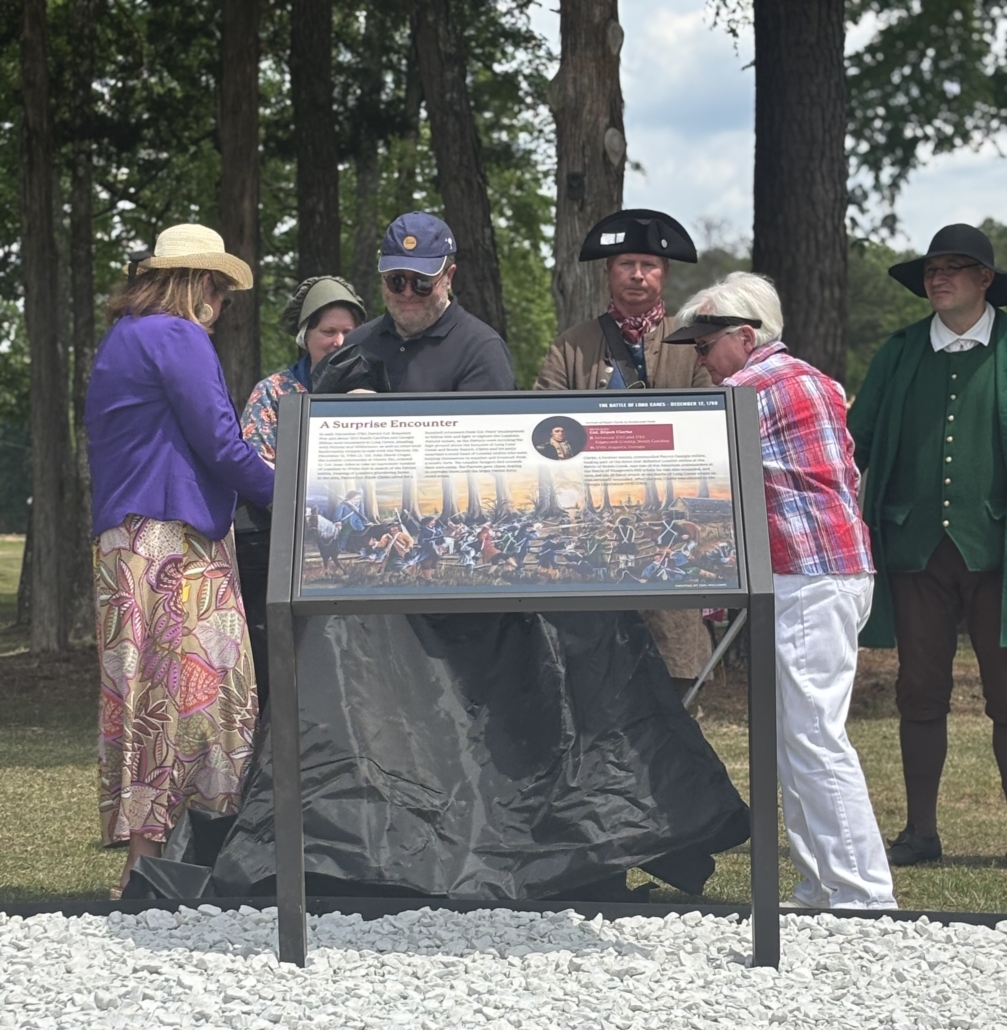
Community members, local dignitaries and history enthusiasts gathered at the Battle of Long Canes Interpretive Signage Installation Service Saturday at Wisteria Park in Troy.
The event was part of the state’s 250th-anniversary celebration of the American Revolution in South Carolina (1770–1783), focusing on education, historic preservation, and tourism. Each county in the state has an SC 250 committee.
The Greenwood and McCormick County SC 250 committees jointly applied for funds for Battle of Long Canes interpretive signage. The State SC 250 Committee awarded the grant and provided $15,000 for the signs. USCOG Government Services Director Rick Green submitted the grant application and helped administer the project.
Several dignitaries spoke before the tarps were removed to reveal reproductions of two Williams paintings and a map which provides special context to the Battle of Long Canes whose exact location is still undetermined.
Green and former McCormick County SC Chamber of Commerce & Visitor’s Center Director Nancy Lindroth unveiled “A Surprise Encounter,” which depicts South Carolina and Georgia militiamen sneaking up on enemy British Loyalists stealing chickens and pigs, etc., from a local farm. The narrative of the painting also refers to the Ninety Six battle site, Colonel Elijah Clarke, Brigadier General Andrew Williamson, and Colonel Andrew Pickens:
“In early December 1780, Patriot Col. Benjamin Few and about 500 South Carolina and Georgia Militia were encamped at Long Canes, pleading with Pickens and Williamson, as well as other local backcountry citizens (for supplies and support). On December 12, 1780, Lt. Col. John Harris Cruger, the Loyalist commander at Ninety Six, ordered Lt. Col. Isaac Allen to take an equivalent number of Loyalists to White Hall in search of the Patriot militia. Hearing of Loyalists plundering farms in the area, Patriot Col. Elijah Clarke called for a hundred volunteers from Col. Fews’ encampment to follow him and fight or capture the Loyalists. Around sunset, as the Patriots were scouting the high ground above the bottoms of Long Cane Creek and Reedy Branch, Clarke and his party surprised a small band of Loyalist militia who were helping themselves to supplies and livestock from a nearby farm. The Loyalist foragers fled towards their own camp. The Patriots gave chase, hoping to overtake them until the larger Patriot force could arrive.”
Williams’ other painting titled “Retreat and Aftermath” referred to the Patriot defeat at the hands of the Loyalists in the Battle of Long Canes, followed by a decision by Pickens to free himself from parole and take a leading role in the pivotal American victory at the Battle of Cowpens in January 1781.
“Clarke’s overconfident Patriots dismounted and hastily advanced across a small rise that had blocked their view of Lt. Col. Allen’s encampment. The Patriots raced in with muskets and were stunned to see hundreds of startled men, including red-coated Regulars, hurriedly fixing bayonets, forming lines, and preparing to fire. The Loyalist counterattack quickly caused a chaotic retreat by the Patriots, of up to three miles, with wagons and plundered livestock abandoned as night fell. The larger Patriot force never arrived. The Patriots took heavier losses, including serious injuries to Clarke and other officers. Most narrowly escaped, although casualty accounts do vary in this skirmish. However, shortly after this Patriot setback, Col. Andrew Pickens renounced his parole and, a month later, commanded the Patriot Militia at the Battle of Cowpens some 95 miles to the north, a victory for the Patriots. The tide of war was again turning towards independence for the colonies.”
After the ceremony concluded, the crowd moved into the Troy Community Center to view the original acrylic paintings…
The process leading up to the unveiling of the interpretive signs was a couple years in the making, President of the Greenwood County Historical Society Chip Tinsley told the crowd before the signs were unveiled.
“For hours upon hours upon hours, we had boots on the ground. We looked for new information. We tried to verify old information. We spent many months looking, researching, finding,” Tinsley said.
“Someone asked me, ‘Why was this an important battle? What did it mean? Why was it something we needed to learn about?’ The Battle of Long Canes was an important event in the back country of South Carolina. And we’re very proud to be a part of memorializing that,” Tinsley added……..
Senator Billy Garrett said, “Ordinary Americans, like you and me, are part of an extraordinary story of the American Revolution. This was not a distant battle. This was our home. These were not professional soldiers. These were our ancestors. These were our neighbors. These were our family members. And our fellow citizens. And yet their story is no less important than all the great battles of the war fought throughout the United States.”
Former McCormick County 250 historian Wayne Ehrensberger implored those in attendance to study the paintings.
“When you see the interpretive signs try to fully absorb the scenes depicted by Eric, which accurately portray fine details of the period, including such things as the long cane growing in the background, specific breeds of livestock — one of which is a personal favorite, and the various types of clothing. Soldiers wearing green coats were members of the British trained NJ Loyalist Volunteers,” he said.
Ehrensberger gave a detailed presentation on the Battle of Long Canes and referred to other battles as well.
“On May 12th, 1780, the British defeated the large American force defending Charleston which inflicted such a staggering blow that many of the South Carolina militiamen feared the war may be lost,” Ehrensberger said.
Skirmishes moved westward with the American Patriots losing the Battle of Camden in August. But the Patriots won the Battle of Musgrove Mill in present day Laurens County a few days later and also at Kings Mountain in October.
Also around that time, the British Loyalists occupied the village of Ninety Six. They wanted Williamson and Pickens on their side, as Ehrensberger further explained.
Efforts by Patriot forces in the Long Cane settlement went beyond simple recruitment. Acting under orders from Major Gen. Nathanael Greene, they sought to harass British troops entrenched at Ninety Six while attempting to bring two key backcountry leaders—Andrew Williamson and Andrew Pickens—back into the fight. Both men were on parole, and reports that the British were courting their allegiance only heightened Patriot urgency. Williamson had already cast his lot with the British, effectively inviting their occupation at Ninety Six, while Pickens remained undecided but ultimately declined to rejoin.
Tensions escalated when British officials pushed for harsher parole terms, a move widely seen by Patriots as a betrayal meant to force neutrality or even turn former comrades against one another……..
The situation worsened after repeated but unsuccessful attempts to persuade Williamson and Pickens. Frustrated Patriot troops retaliated by raiding Williamson’s property at White Hall, seizing provisions intended for British forces. Cruger dispatched roughly 450 troops under Isaac Allen to pursue the Patriots, hoping to catch them off guard.
What followed was a costly miscalculation. A Patriot detachment under Colonel Clarke, expecting only minor resistance, encountered Loyalist militia foraging a local farm and attacked. But in pressing forward, they unknowingly advanced into Allen’s full force. …….
The Loyalists quickly regrouped, formed ranks, and launched a fierce counterattack. Clarke’s men, suddenly outmatched, fought desperately as reinforcements failed to arrive. Clarke was severely wounded, and other officers, including Lt. Col. James McCall and Major John Lindsay, suffered devastating injuries amid the chaos.
The Patriots ultimately broke and retreated under heavy pursuit. Survivors regrouped only to find their main camp already in withdrawal, reportedly ordered by Colonel Few. Under cover of darkness, the battered force scattered – some fleeing toward Georgia, others toward North Carolina – abandoning supplies and livestock. The clash underscored both the volatility of divided loyalties in the backcountry and the high cost of misjudgment in a war where intelligence and timing often proved decisive.
“It was a confounding Patriot loss. But it was also the beginning of the end for the British,” Ehrensberger said, referring to future Patriot victories at Cowpens and other locations in the South.
Upper Savannah Land Trust Director and Greenwood 250 Commissioner Wade Harrison talked about the location of the Battle of Long Canes, which is still up for debate……..
“That is one of the maddening questions that actually remains unanswered: where should we put the marker for the Battle of Long Canes,” Harrison asked.
“I think it is important to understand here that questions, uncertainties, and gaps in knowledge do not mean that historians have somehow failed. It means the study of history is still relevant, and there is still a lot to learn, and that stories we’ve been comfortable with can be challenged with new evidence, fresh analysis, and just finding stuff (skirmish artifacts) in the woods,” Harrison said.
“This is what history is supposed to do, and it’s happening even as we commemorate these historic events,” Harrison said.

